
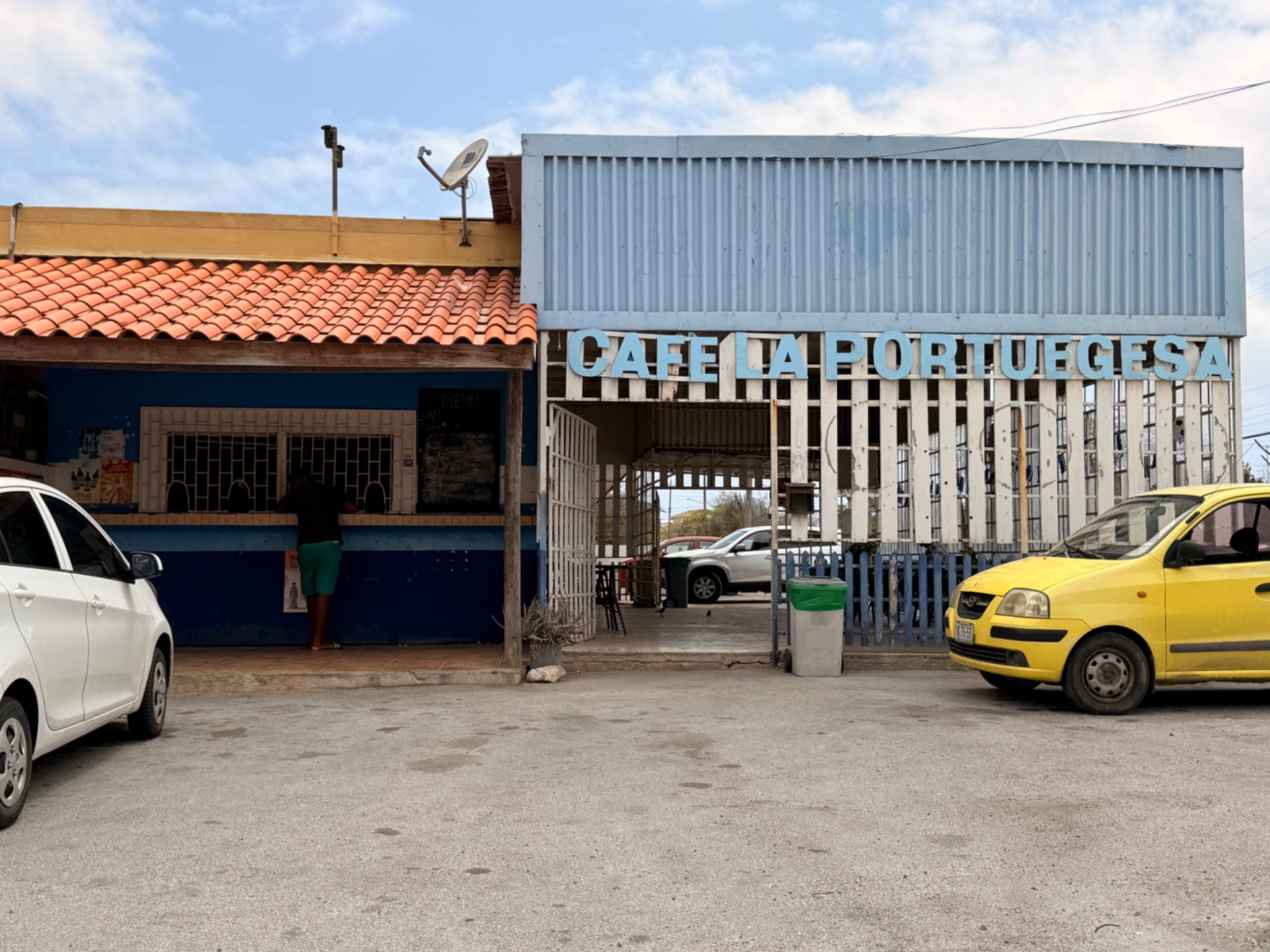
Foto: Cafe La Portuegesa, un lugar real en Snekkie
Tours · 8 min de lectura
What Is a Snek Tour? Curaçao's Best-Kept Food Road Trip Secret
Publicado el 26 de mayo de 2026
What Is a Snek Tour?
A Snek Tour is exactly what it sounds like — a self-driven food road trip through the snekkies of Curaçao. You get in a car, you pick a direction, and you eat your way across the island, stopping at local snack bars wherever the mood takes you. No tour bus, no itinerary printed on glossy paper, no guide with a microphone. Just you, a rented car (or your tía's Hyundai), and a nose for good food.
The word snekkie comes from the Dutch snackbar, but a snekkie is something far more specific than a chip shop. It is a neighbourhood institution: a small, usually family-run spot where locals eat, drink cold Polar beers, and play domino for hours on end. You will find them tucked into residential streets in Willemstad, sitting at dusty crossroads in Bandabou, and parked next to gas stations on the road to Westpunt. They are everywhere, and they are almost invisible to anyone who does not already know to look.
A Snek Tour is the deliberate act of making snekkies the point of the journey. Instead of treating them as a pit stop on the way somewhere else, you plan your route around them. Morning pastechi in one neighbourhood, a cold beer and keshi yena at lunchtime, truki pan after sunset. The whole island becomes the menu.
This is not a walking tour. Curaçao is a driving island — the snekkies are spread across 444 square kilometres of coastline, hills, and kunuku. You need wheels.
Why Snekkies, Not Restaurants?
Here is the honest answer: snekkies are where Curaçao actually eats. Not the waterfront restaurants in Punda that charge tourist prices for keshi yena, and not the hotel buffets with their safe, flattened versions of local dishes. The snekkies are where the food still tastes the way it was supposed to taste, because the woman making it has been making it the same way for thirty years, and her mother made it before her.
Walk into a proper snekkie and you will find the menu handwritten on a whiteboard (if it is written anywhere at all). You might order by pointing. The portions are generous, the prices are honest, and the plastic chair you sit on has probably survived three hurricanes. Nobody is performing authenticity for you — they are just open for business, same as always.
Snekkies are also where Curaçao socialises. The domino culture is real and it is central. A group of men arguing over a domino table at 2 p.m. on a Tuesday is not a cliché — it is just Tuesday. You are welcome to watch, and if you are there long enough and speak a little Papiamentu, you might get invited to play. Dushi moments — sweet, lovely, unexpected — happen constantly in snekkies, if you let them.
The other reason to choose snekkies over restaurants is economic. When you eat at a snekkie, the money stays hyper-local. Most of these spots are a single family operation. The pastechi were fried this morning by someone who woke up at five. That matters.
A Day on a Snek Tour: Stop by Stop
To make this concrete, here is how a full Snek Tour day might actually unfold. This is not a fixed itinerary — it is more of a rhythm, a template you adapt to whatever you find along the way.
Morning: Pastechi and Coffee
Start early, around 7:30 or 8:00. The first stop is always a pastechi — a deep-fried pastry filled with cheese, tuna, or spiced beef, depending on the snekkie. Pastechi are the breakfast of Curaçao. They are made fresh every morning and they are usually gone by 10:00, so early matters.
Pair your pastechi with a small cup of strong local coffee and you are set. The atmosphere at this hour is unhurried — school runs, workers grabbing food before a shift, old men already at their usual table. It is the best time to feel like you belong somewhere.
Mid-Morning: Drive West into Bandabou
After breakfast, point the car toward Bandabou — the rural western half of the island. The roads get quieter, the landscape opens up into dry hills and sea views, and the snekkies you find out here tend to be even more local than the ones in Willemstad. Some of them have no sign. You know they are open because there are cars outside and a smell of frying coming from somewhere behind a corrugated fence.
This is the exploratory part of the tour. Stop when something looks interesting. Trust the cars parked outside more than any review.
Lunch: Keshi Yena at a Neighbourhood Snek
By midday you want a proper plate. Keshi yena — a hollowed-out Gouda cheese shell stuffed with spiced chicken or beef, slow-cooked until it almost collapses — is the national dish of Curaçao and one of the most misunderstood. When it is good, it is genuinely extraordinary. Snekkies that make it from scratch are the only place to find it at its best.
Order a cold Polar beer — Curaçao's local lager, always served in a glass that has been sitting in the freezer — and find a table in the shade. This is the long stop. Eat slowly.
If you are staying in or near Willemstad, make a detour to Plasa Bieu, the old market in Punda where a handful of market ladies have been serving traditional plates for decades. It is a little more known than a pure neighbourhood snekkie, but the food is the real thing and the atmosphere is unlike anything else on the island.
Afternoon: Netto Bar, Otrobanda
No Snek Tour is complete without stopping at Netto Bar in Otrobanda, Willemstad. It is over 70 years old, which makes it one of the oldest operating snekkies on the island. The interior has barely changed. The drinks are cheap and cold. The clientele ranges from construction workers to architects and everyone in between — that is what a proper snekkie looks like.
Order a Ròm Bèrdè — Green Rum, the iconic local spirit of Curaçao. Not Blue Curaçao, which is for cocktail menus at beach clubs and tourists who want something that looks like the Caribbean. Locals rarely drink it. Ròm Bèrdè is the real thing: sharp, slightly grassy, unmistakably Curaçaoan. Sip it slowly. Watch the street.
After Dark: Truki Pan
When the sun goes down, the truki pan comes out. These are former bread delivery trucks — pan is bread in Papiamentu — that have been converted into mobile BBQ and grill kitchens. They set up in the same spots every night: outside clubs, near the waterfront, at the edges of neighbourhoods where people gather after hours.
The truki pan menu is simple: grilled chicken, ribs, sausage, fried plantain, sometimes noodles. Everything smells incredible because it has been cooking over charcoal in a repurposed bread truck for the past two hours. This is late-night Curaçao at its most vivid, and it is the perfect last stop on a Snek Tour.
The Snekkie App: Your Snek Tour Navigator
The single biggest challenge with a Snek Tour used to be finding the snekkies themselves. They are not always listed on Google Maps. They do not always have websites. They appear and disappear based on seasons, family circumstances, and the particular mood of the owner on any given day.
The Snekkie app was built specifically to fix this. You can discover all snekkies on the map — an interactive, community-maintained map of snack bars, truki pan spots, and local food stops across the entire island. Each listing shows what the spot is known for, which neighbourhood it is in, and what other visitors have experienced there.
More useful still: you can start a curated Snek Tour route directly in the app. These are routes designed by people who actually know the island, built around real snekkies, with a logical driving sequence from stop to stop. You follow the route at your own pace — the app tracks where you are in the sequence so you always know which spot comes next and how far away it is.
Think of it as having a local friend who planned the day for you. One who actually eats at snekkies, not one who visited them once to take a photo.
Snek Tour vs. Standard Food Tour: What's Actually Different
Food tours are popular in Curaçao. You will find them advertised at every hotel reception desk: a guide, a minibus, five or six stops, a curated narrative about colonial history and spice trade routes. They are fine. They are not a Snek Tour.
Here is the actual difference:
- You are in control. A Snek Tour moves at your pace. You stay at a snekkie for twenty minutes or two hours. Nobody is herding you back onto a bus.
- The stops are genuinely local. Organised tours tend to gravitate toward spots that can handle a group of twelve and accept card payments. Snekkies are often cash-only, table-for-four maximum, and utterly indifferent to tourist logistics. That is the point.
- You encounter actual Curaçao. When you walk into a snekkie unannounced, you are seeing how the island actually functions on an ordinary day. The domino games are real. The arguments are real. The laughter is real.
- The food is dramatically cheaper. A full plate at a snekkie rarely costs more than ANG 15–20. A curated food tour runs ten times that, minimum.
- It is endlessly repeatable. You can do a different Snek Tour every weekend for a year and never repeat the same combination of stops. The island is deep enough for that.
The Best Time for a Snek Tour
Curaçao sits outside the hurricane belt, which means the weather is reliably good year-round. There is no bad season for a Snek Tour from a climate perspective — you are going to get sunshine almost regardless of when you go.
The better question is what time of day to start. The answer is early. Most snekkies open between 6:30 and 7:30 in the morning and run until they sell out, which for pastechi can happen before noon. Starting early also means you avoid the worst of the midday heat on any outdoor stops, and you arrive at the truki pan at exactly the right hour — late enough that it is fully operational, early enough that you can still eat without a forty-minute queue.
Weekends tend to bring more locals out to snekkies, which makes for a livelier atmosphere but also longer waits at popular spots. Weekday mornings are quieter and more relaxed. Both are worth experiencing.
Carnival season — running from January through February — is a special case. Snekkies around the parade routes run extended hours and sometimes serve food you will not find any other time of year. If you happen to be on the island during Carnival, a Snek Tour becomes an entirely different and even more vivid experience.
Build Your Own Snek Tour
Once you understand the rhythm, you can build your own route from scratch. Here is how to approach it:
- Pick a direction, not a destination. Bandabou, the eastern coast toward Jan Thiel, the neighbourhoods around Otrobanda — each has its own character. Pick one axis and follow it, rather than zigzagging back and forth across the island.
- Plan three anchor stops. A morning pastechi spot, a lunch plate stop, and a truki pan location for the evening. Everything in between is improvisation.
- Leave room to deviate. The best discoveries on a Snek Tour are the ones you did not plan. If you see a hand-painted sign on a residential street and there are two cars parked outside, stop. That is your fourth stop now.
- Carry cash. Many snekkies still do not accept cards. ANG 200 in small bills will cover a full day with comfort to spare.
- Learn three phrases in Papiamentu. Bon dia (good morning), danki (thank you), and kon ta bai? (how is it going?). That is enough to open doors that stay closed for people who do not try.
- Use the Snekkie map before you leave. Spend ten minutes on the discover page to identify what is in each area along your planned route. You are not committing to every pin — you are just giving yourself a shortlist to work from when you get there.
The best Snek Tours are the ones where you planned three stops and ended up at seven. That is not a failure of planning. That is exactly how it is supposed to work.
Ready to Start?
A Snek Tour does not require a special occasion. It does not require a group. It does not require advance booking, a confirmation email, or a voucher. It requires a car, an appetite, and the willingness to drive toward something you have not tried before.
Curaçao is a small island with an enormous amount of food culture packed into it — more than most people discover in a week, or even a month of visits. The snekkies are the fastest way to access that culture directly, at street level, without mediation or performance.
Open the map, find a neighbourhood you have not been to, and go. The pastechi are waiting. The Polar beers are in the freezer. Somewhere on a side street in Bandabou, a woman you have never met is making keshi yena that is going to change your understanding of what Curaçaoan food can actually taste like.
That is a Snek Tour. It starts whenever you are ready.
Start a curated Snek Tour route and let the island do the rest.